Tag: Canon

  • Comparing Analog and Digital Film

    A few weeks back, I took my analog camera — a Canon AE-1 Program — for a walk in Haugesund, a city on the west coast of Norway.

    I also brought along my Canon 5D Mark II for three reasons:

    1. Take comparison shoot (which we will look at today)
    2. Verify that the light meter in the AE-1 is working correctly (it is)
    3. Be able to take more pictures once the 24 frames were used.

    Just to get the technical out of the way.

    Canon AE-1 Program:

    • Fujifilm Superia 200 film, 24 frames
    • 50mm f/1.8 lens

    Canon 5D Mark II:

    • RAW and JPG
    • Kodak Portra 160 NC picture profile for the JPGs
    • 50mm f/1.4 lens
    • ISO 200 to match the film speed on the AE-1

    Regarding the picture profile; the Kodak Portra 160 is from the 158 pack of picture profiles from Cinescopophilia. I have written about picture profiles earlier.

    In the images below I have only used the RAW files and applied both the picture profile that was set in camera and the standard picture profile that comes with the camera using Canons Digital Photo Professional program.

    I chose these images because of the colors. I do not believe they are masterpieces on their own.

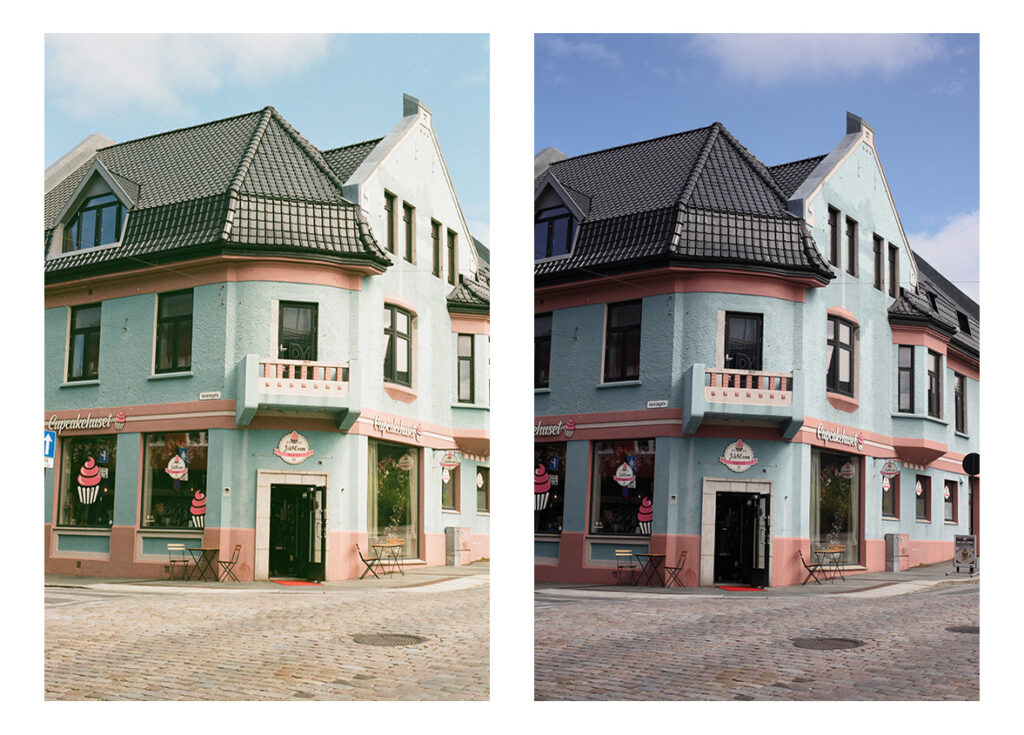
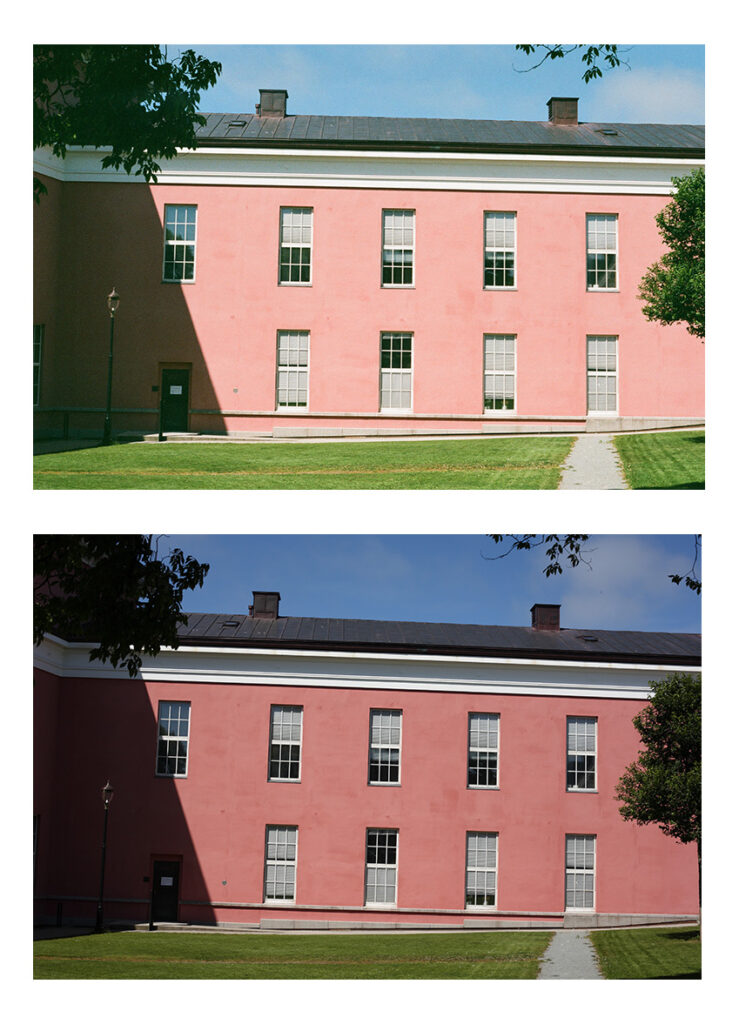
    Analog on the left, or top. Digital images on the right, or bottom.
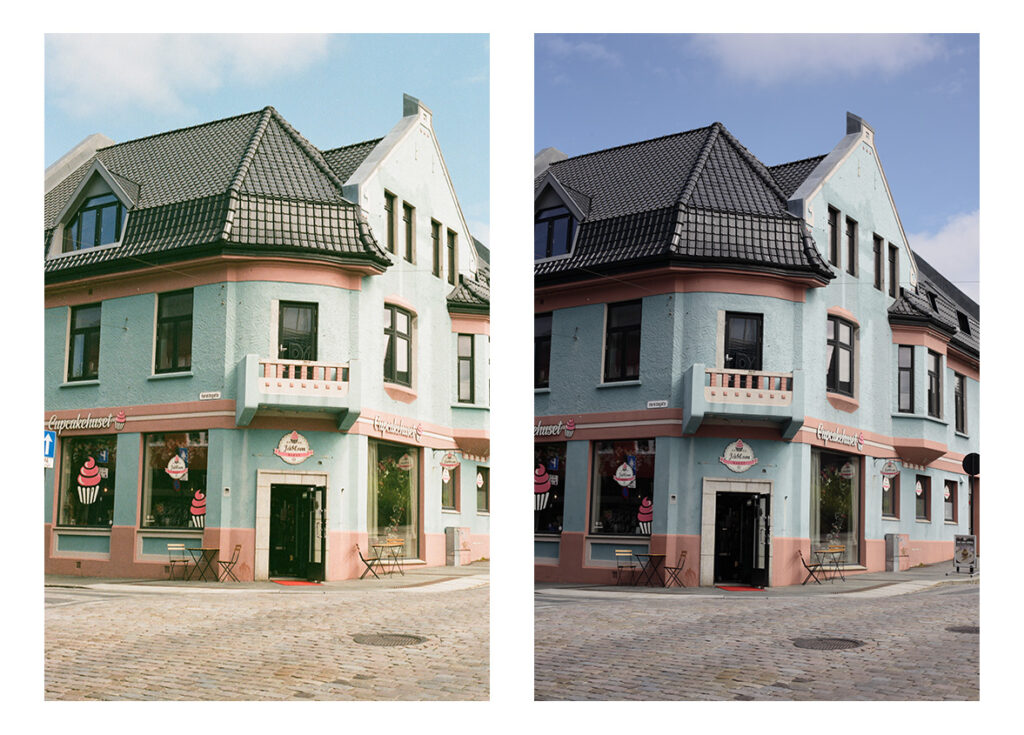
    I tried some of the picture profiles in the 158 pack, but none of them got close to the colors produced by the Fujifilm Superia.

    It’s quite distinct, no doubt about it.
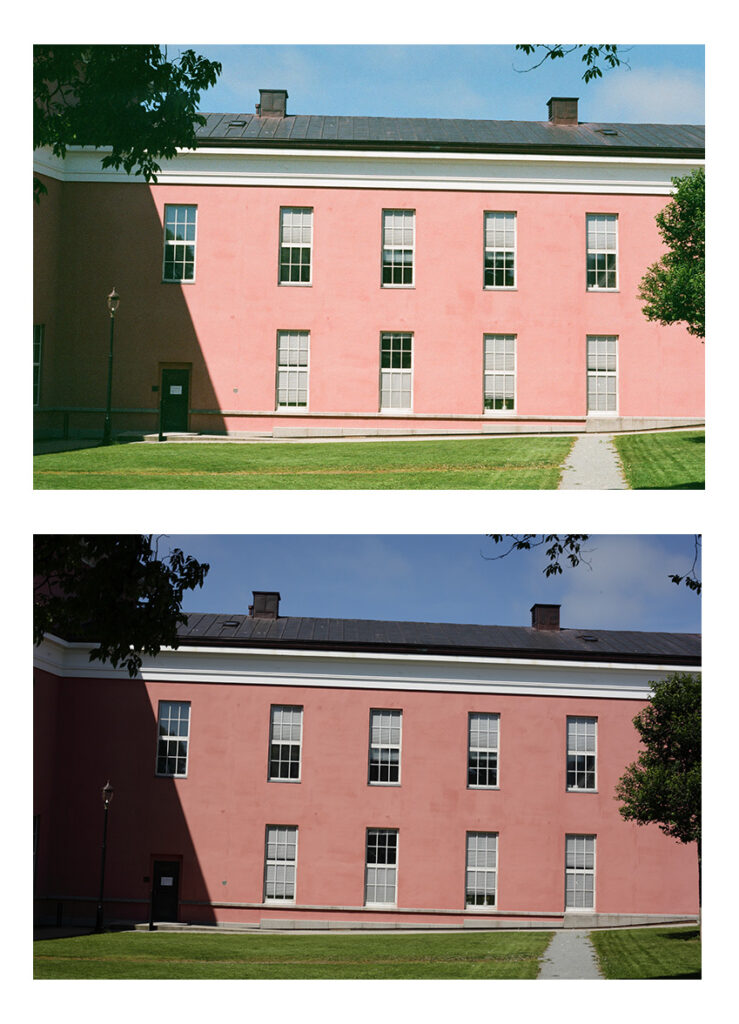
    Once again it is easy to spot the difference.

    The analog picture seems brighter, even thought the settings are identical. So either the film is a bit more sensitive, it has been processed slightly differently, or the light meter is a bit off1.

    Since I took the images in RAW, I could try to push the exposure a bit to see if I can get a better match. However, I still don’t think it will match the colors. Especially on the blue in the first picture.

    I also tried to do a double exposure, but that failed twice.

    First, the double exposure was way off. Not even worth showing the image, it’s just a mess.

    Secondly, I was not able to align the frame correctly, so the double exposure was both on the frame I intended to double expose, and part of the next frame, as show in the image below.
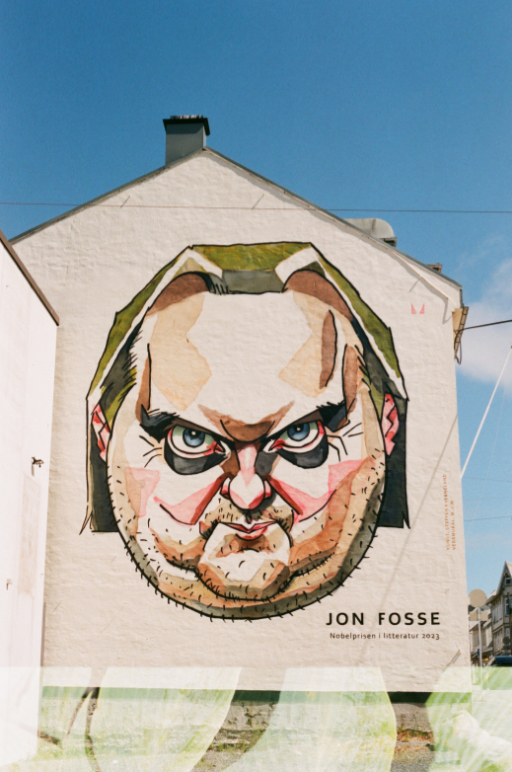
    I think the Fujifilm Superia 200 has the “look and feel” of the 90s. It also handles overexposure a lot better than its digital counterpart.
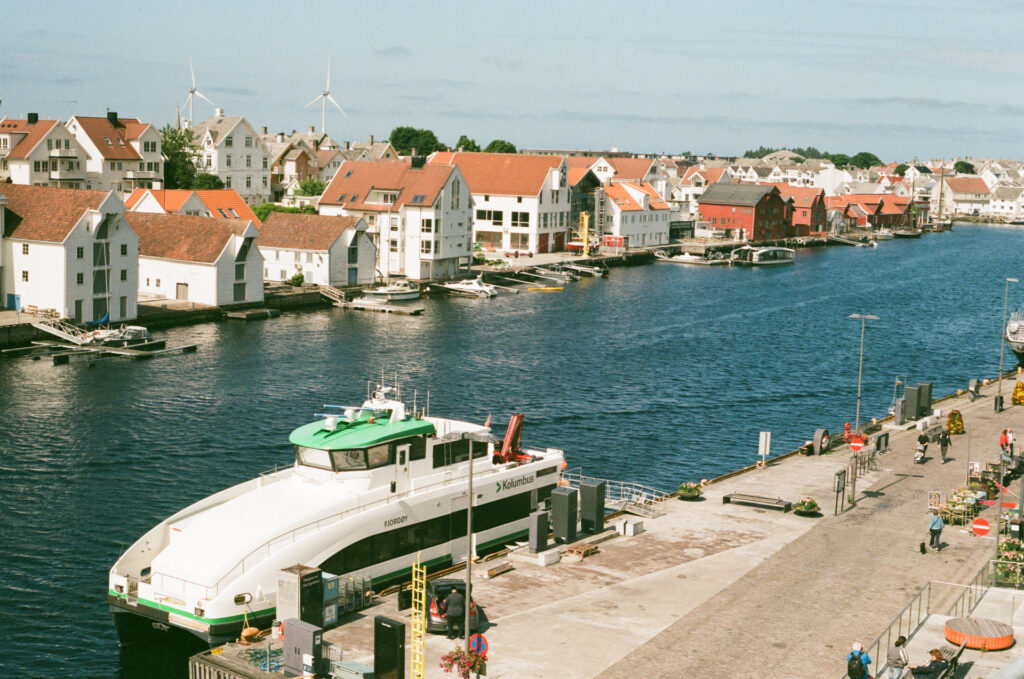
    The next film I will be shooting is the Kodak Gold 200. I will try to do the same exercise where I take the same shots with the Canon 5D Mark II with the same settings and compare them.

    I’m also thinking about getting my hands on the Kodak Portra 160 since I have at least 3 picture profiles that claim to be close to that film.


    1. After I had published, it occurred to me that it could also be the timing of the shutter that is slightly “off” on the Canon AE-1 Program. If I adjust the exposure on the digital image by +0.75 it seems to match much better. ↩︎

  • Shooting Analog Film in 2026

    I’ve spent the better part of the summer isolated at home due to a rather nasty virus. However, recently I have been feeling well enough to go for short walks, and on one such occasion I decided to bring along my Canon AE-1 Program — an analog film camera — with a 50mm f/1.8 FD lens. A classic combination.

    In the camera I had a roll of Fujifilm Superia 200, 24 frames, that was stored in my fridge for a few years. Could be anything from 2–6 years. I don’t remember.

    I also brought along my Canon 5D — I think it sounds better than my 5D mark II — paired with a 50mm f/1.4 EF lens. On this camera I shot both RAW and JPG, where the JPG was processed with a Kodak Portra 160 picture style in camera.

    Yes, you can install different picture styles on newer Canon cameras. And by newer I mean from late 2005, like the classic Canon 5D, but not early 2005, like the Canon 350D. More on picture styles later.

    Some of the shots I took with both cameras, and I am looking forward to compare the results. But for the most part I just used the analog camera.

    Using a analog camera, in manual mode, with manual focus, forced me to slow down. Everything had to be checked and double checked. Focus. Exposure. Framing. There is no way to check the result on a screen and try again.

    And yes, I know the AE-1 Program has a program mode — it’s in the name. But I like to shoot in manual, I do so on my digital cameras as well, except for the OM System TG7. But that’s for a different kind of shoot, where time is not on your side.

    My first DSLR

    This experience made me curious, so I charged the battery on my Canon 350D — my first DSLR — and took it for a walk as well.

    The 350D, as mentioned above, does not support picture styles. You can, however, tweak some parameters, which I did after doing some simple research. Well, used an internet search engine to be more precise.

    The shutter sound on the 350 is what I would call “light and cheerful”. It has a smaller sensor, and thus also a smaller mirror and shutter curtain. But it’s noticeable slower writing files to the CF-card than the 5D.

    I also have the 5D mark II, and for some reason this camera sounds different from the original 5D. To be honest, I’m not a fan of the shutter sound at all.

    Camera equipment

    The danger of picking up and using all my cameras is of course that I now suddenly find myself searching for more camera equipment. And that is a deep, and expensive, rabbit hole.

    So far I have looked for other Canon EOS analog cameras, because I have already invested in EF lenses, only apparently not enough, because I’ve also been searching for lenses. Especially prime lenses, like this beautiful Canon 50mm f/1.2.

    Also, after a few YouTube videos, I have searched for Leica, especially the Leica M6, which seems to be the holly grail of Leica film cameras.

    I guess it would make more sense to buy a digital Leica M, like the M9 or M10, but damn it is expensive. However, it would make me one of the cool kids. Yes, I know that the Leica M11 is the newest, but if the M9 is expensive used…

    Picture Styles

    Since you asked.

    A few years ago, I discovered a site with 158 Canon dSLR Picture styles picture profiles. Here is how to install the picture styles, or, if you prefer, a YouTube video on how to install picture styles on Canon.

    Thomas Fransson, from the YouTube video linked above, also makes his own picture styles, which you can download for free — or you can give a small donation.

    A quick note: The picture styles from Thomas is in the pf3 format, which is only supported on cameras from 2007 and onwards — like the 5D mark II, but not the 5D classic. The 5D classic support only the pf2 format. However, cameras that support pf3 also support the pf2 format.

    On the Canon 5D I have installed the following picture styles at the moment:

    • Fuji Velvia
    • Kodak Portra 160
    • BW_5

    And on the Canon 5D mark II, I have these:

    • Fulji Velvia
    • Kodachrome 25
    • BW_5

    They are all from the 158 pack I mentioned.

    Just to make it clear; the picture styles installed on the Camera only affects the JPG images. It does not affect RAW images, so if you want to actually get any effect, you have to shoot JPG (you can shot both RAW + JPG) — or apply them in post using Canons software.

    The pictures

    Well, sadly, the 1-hour photo lab seems to be out of fashion, so I just have to wait to get the pictures back. I was told it could take up to 3 weeks.

    For the digital photos; I was not that happy with them. Not from the 5D or the 350D. Which can mean only one of two things: I’m a bad photographer, or it’s the equipment. So, obviously, I’m still looking at Leica M-series online.

    I might share the images once I get them back from the lab. I still have faith in them.

    Then I will probably also show the comparison with the pictures I took with the Canon 5D from the same location and with the same settings.

  • Fotoshoot med Focaccia

    Focaccia

    For noen dager siden fant jeg en oppskrift på Focaccia som bare måtte prøves. Og når jeg først var i gang rigget jeg like godt opp noen blitslys og dokumentere resultatet.


    Jeg skal ikke skrive noe særlig om selve bakeprosessen, den er nemlig rett frem når man følger oppskriften. Deigen ble satt kvelden i forveien, så den hadde god tid til å heve seg.

    Oppsettet

    Litt om selve lysoppsettet. Alle bildene ble tatt med blitslys på stativ fra kamera venstre, denne blitsen ble satt til 1/64 styrke. Det er en hvit paraply mellom blits og bakverk for å gjøre lyset mykere. I tillegg til det lyset så har jeg på det øverste bilde gjemt en blits bak Focacciaen med styrke 1/128. Det er dette lyset som gjør at saltflakene på toppen glinser (se bilde under for eksempel med og uten ekstra blits).

    Focaccia

    Jeg prøvde ulike vinkler og oppstilling av bakverkene, men jeg ble mest fornøyd med bilde hvor vinkelen er rett på. I utgangspunktet forsøkte jeg å skjære en bit så tynn at blitslyset skulle vise igjennom Focacciaen, men det viste seg at bakverket var for mykt til at jeg klarte å skjære tynt nok.

    Focaccia

    Utstyr

    Bildene ble tatt med Canon 5D Mark II og et  Canon 100mm macro-objektiv. Blitsene var Canon Speedlite 580EX II som ble fjernstyrt med Yongnuo RF-605C. På hovedlyset brukte jeg en hvit paraply for å få en mykere lyskilde.

    Ta kontakt hvis du ønsker å bruke noen av bildene, så kan vi gjøre en avtale.

    Klikk på bildene for å se dem i større størrelse.


  • Pentax AF-330FTZ and Hanimex 325AZ Trigger Voltage

    Just a short post about camera flashes and trigger voltage.

    Canon specifies a safe trigger voltage up to 6 volts using the hotshoe on their digital cameras. If it’s higher, it might damage the camera. So I have measured the trigger voltage on two older flashes I have lying around, since I didn’t get (m)any hits searching the interewebz.

    Pentax AF-330FTZ has a trigger voltage of 3.14V
    Hanimex 325AZ has a trigger voltage of 110V

    So the Pentax AF-330FTZ should be safe. Hanimex 325 however, isn’t. What’s kind of scary is that I have used the Hanimex on several occasions on my 350D. Luckily no harm done (as far as I can tell).

    Update: Found this web page explaining some more around this issue.

    I take this to mean that all Canons DSLRs newer than the 350D, as well as all the professional models, can use flash with trigger voltages up to 250 volts in their hot-shoe. However, 6 volts is the safe limit for the D30, D60, 10D, 300D, and Canon’s digital compact cameras.

  • Fordeler ved å fotografere i RAW-format

    Klikk på bilde for større versjon

    Det er ganske utrolig å se hvor mye som kan reddes i et bilde tatt i RAW-format. I bilde ovenfor kan man se at orginalen manger kontrast, og dermed fremstilles som grå og kjedelig. Bilde til høyre er resultatet etter en rask behandling i Adobe Lightroom. Kontrasten er gjennopprettet og dermed kommer fargene klarere frem. Det er naturligvis ønskelig å få best mulig resultat rett ut av kamera, men i dette tilfellet hadde jeg vært litt uheldig med innstillinger, samt at jeg skulle nok ha brukt solblender. Skal heller ikke se bort fra at UV-filteret på objektivet burde vært renset. Men er man først uheldig er det greit å vite at mye kan rettes i etterkant.

    Bjergafjellet